Spaceweather.com always has the most interesting news. The site is run by Dr. Tony Phillips, a science writer for NASA and high school teacher in Bishop, California.
His students launch balloons to the edge of space to conduct research and to carry up trinkets that they sell to fund their missions. If you scroll down on the linked page, you'll see one of the silk roses they sent up on a recent mission.
Back then, it was used to develop algorithms for real-time MPEG-2 encoder silicon. It can also be used to look at strategies used by other encoders (for example, ffmpeg). MPEG-2 video is still being used today, so it's still relevant.
Here's another screenshot showing the options available with the tool. You can switch between the picture (shown), macroblock type, macroblock quantization, number of bits per macroblock, motion vectors (shown in the previous screenshot) and coded block pattern.
> About 15 minutes before the disturbance in Norway, the interplanetary magnetic field (IMF) near Earth abruptly swung around 180 degrees, and the solar wind density jumped more than 5-fold. Earth may have crossed through a fold in the heliospheric current sheet--a giant, wavy membrane of electrical current rippling through the solar system. Such crossings can cause these kind of effects.
Would this type of event potentially affect human behavior, such as sleep patterns?
I am genuinely curious because, anecdotally, my son and I had a difficult night sleeping and a friend said she and her son also had difficulty sleeping that night.
Care to ELI5 why this is so special? It sounds impressive but I have no idea what an IMF, heliospheric current or a membrane of electrical current are.
It's been a while, but I did take an astrophysics class that got into the solar system's electromagnetic dynamics.
As I recall, the sun is constantly shedding ionized material known as solar wind. This plasma carries the magnetic field from the sun with it. From "above", the magnetic field looks like a giant spiral with the sun at the center.
It sounds like the earth may have moved through a particularly dense spot of the solar wind which interacted strongly with the Earths magnetic field. This would probably also cause unusually strong auroras.
That's about the extent of my knowledge (plus I'm on my phone and it's a bit difficult to get into a lot of detail). I'm sure someone else around here can correct me and/or give more insight.
Am I understanding the article correctly? They're guessing that because there was no solar wind which would normally trigger aurora, the Earth must have passed through a sort of rogue wave in the heliosphere, which also was strong enough to induce a current in the ground?
Not rogue. And I'm unsure if wave is the correct term. I think what they're implying is that when passing through a "fold" in the heliospheric current sheet (https://en.wikipedia.org/wiki/Heliospheric_current_sheet) the polarity flips. I presume that the tighter the fold, the less distance between the polarity change, the greater the induced current; tight enough and the polarity is different between two close points on earth, inducing a greater than normal current.
But I didn't pay enough attention in high school physics, so....
It can even kill tons of animals/people at once[1]. Four legged animals are more vulnerable than humans, since the voltage across your heart depends on how far apart your feet are. Also, we wear shoes.
Imagine how spooky it would be to be struck by ground current without understanding... Whether or not you survive could depend entirely on what direction you're standing. One direction will mean your feet are at different voltages and current jumps into your nice conductive veins and arteries, all passing right through your heart. The other direction means the front and back of each foot is at different voltages, and you may not even feel it. Hundreds of people just drop dead of heart attacks around you.
Well, that would be the ground current of a lightning strike, the induced ground current of a solar event is much much lower, it only plays a role with long wires.
I'm not aware of anything like "voltage density", what do you mean by that?
The potential gradient is the thing that kills you. It can either be created by a lightning strike or by voltage induced into the ground as mentioned here.
Fun fact, voltage gradient across cell membranes is typically megavolts per meter. At scale that is millivolts per nanometer, but the field strength is the same either way. Membranes are badass.
EDLC's operate at several gigavolts per meter, across a gap only atoms thick. They actually do it the same way as a cell wall -ELD stands for electrostatic double layer- by lining up two sheets of polar molecules, with charges facing each other.
Space weather events can have measurable effects on electrical things that are supposedly grounded.
The 1989 coronal mass ejection caused lots of problems with radios, which is probably one of the better known side effects of a solar storm. But it also took out power grids because utilities got a phantom current that just showed up out of nowhere on their long cables. This current can also cause problems for other long metal things buried in the ground like oil pipelines.
IIRC a similar event in the 19th century electrocuted a bunch of telegraph operators. They unplugged the power as a safety measure, but the Earth's magnetic field generated so much current in the telegraph cables that they still worked.
> event in the 19th century electrocuted a bunch of telegraph operators.
True but you are underselling it a bit. Aurora was seen as far south as Colombia and in Colorado it reportedly was bright enough to wake people up because they thought it was day.
It is assumed that had that occurred today it would have fried the power grid on at least a continental scale.
I honestly think it’s crazy that we don’t give this more attention as a society. Like, there is serious talk that we need to look out for Asteroids. But nothing about hardening ourselves against the next high output solar event, which seems more likely to be a problem.
That's because blowing up asteroids is sexy, but hardening the grid is work.
You can't make a movie out of the latter, so nobody cares.
See, also, why people love sexy non-solutions to problems we don't have (let's colonize Mars), but turn their noses at solving real problems, which affect billions of people (climate change). You can't make a slick film about a superhero convincing people to cutting back on their energy use, and to carpool, or bus to work. It's not sexy.
"In August 2018, NASA's Parker Solar Probe launched to space, soon becoming the closest-ever spacecraft to the Sun. With cutting-edge scientific instruments to measure the environment around the spacecraft, Parker Solar Probe has completed three of 24 planned passes through never-before-explored parts of the Sun's atmosphere, the corona."
Warning of a possible CME-induced electrical storm. The visible signature alone isn't proof.
The actual EMF effects, based on both the nature and targeting of the CME, aren't clear until it encounters some electrically-aware monitoring device. Of which most are in Earth orbit.
If countermeasures include such activities as widespread disabling / disconnecting of major grid elements and equipment, you'll want to minimise the false alarms, both on the basis of cost and because of the boy-who-cried-wolf factor.
Oh, not that again. The last time this came up I pointed people at the PJM website, where you can read "PJM 101" and the section on geomagnetic disturbances, written for the people who are in the control rooms where such problems are dealt with. Yes, it's a problem, and it can cause outages, not for most of the reasons given here. The problem is that minor DC currents can cause transformer saturation, which reduces their capacity and causes them to overheat. It's not hard to detect this, and trip a breaker, and some key points in the US power grid have that protection.
> Electrocution can refer to both death and injury via electrical shock.
I don't like being pedantic about language but given that the word is literally just a portmanteau of electricity and execution it's stupid to use it to refer to something other than death. It's not like execution can refer to someone being hurt. The only reason to use it to describe something nonlethal is because you don't realize that execution is part of the word.
Besides, "electrocuted" is a useful word and much less cumbersome than "killed via electrocution". We already have shock, arc, flash and burn for injuries and no other word to clarify lethality.
Language and meaning evolves. Dictionaries aren't prescriptive, they report how words are used. Electrocution is currently defined as killed or injured by electricity by both Websters and Oxford, so it's a meaning that's caught on both sides of the Atlantic.
So I think that ship has sailed, whether you like it or not.
My point is that the definition of execution hasn't changed, and derived words shouldn't either, to minimize confusion.
This is also a plea from an actual electrical engineer, because we generally use it to refer to death. It would be nice if everyone else did too because it's useful.
"To electrocute" is a lot like "to hang" or "to bisect" or "to draw and quarter": it's a way to attempt to kill something. It doesn't necessarily succeed. You can be electrocuted successfully, or electrocuted unsuccessfully. Suffering an "electrocution injury" is like suffering a "hanging-related injury": it means that something tried to kill you, and you escaped less-than-fully dead. In legal terms, it's what causes someone to be charged with the crime of attempted murder.
This reminds me of a "hilarious" conversation I had one time when I was in the casualty ward of the local hospital.
"So there I was at home and I cut through an electrical cable with some scissors."
"And you came to A&E because you got shocked?"
"Well I was shocked, yes. I didn't expect the cable to be live, there was a big bang and all the lights went off"
"OK you've had an electric shock?"
"No I was surprised, I was not electrocuted"
"So why are you here ..?"
(Paranoid partner made me go, though I was certain I was fine. Had some fluid taken from my spine; apparently electric shocks can cause "stuff to break down" and they were gonna use the fluid to confirm whether I'd been hit by electricity or not.)
Not sure if "to bisect" and "to draw and quarter" are so similar here. I mean, if you say that someone is bisected, or drawn and quartered, the meaning is pretty much that he's dead!
Wikipedia asserts that it only refers to death by electric shock: https://en.wikipedia.org/wiki/Electrocution I agree it should only mean that. "Electric shock" is the term for something that hurts but doesn't kill.
True but it mostly refers to death via electric shock or severe injuries due to electric shock—which isn’t surprising since the word was coined to mean death by electric shock.
Look like the data comes from a NASA satalite that tracks measurements for space weather and related scientific missions. Monitoring/forecasting space weather, especially solar effects and impacts, is important for detecting solar flares and ejections that can disrupt electronics in space and on the ground.
Considering that the ground is "ground", I highly doubt that. The article states that "While currents flowed through the ground, auroras filled the sky.".
There may be a correlation between the currents and weather/natural events.
The electrical grid is literally connected to ground at points that can be separated by hundreds of miles. Ground currents cause those points to be at different voltages. Since the wire is very low resistance, this can cause very bad damage if the protection fails.
> There may be a correlation between the currents and weather/natural events.
Ground currents are caused by the same thing as Auroras, in addition to normal weather. They occur constantly to a small degree. They are a problem everywhere in the world; if you lay out a 100 mile metal wire without taking proper precautions to make it safe electrically it will quickly start creating very dangerous discharges.
Think about it this way. It's very dangerous to fly a kite in a thunderstorm; the line will conduct electricity and makes it much more likely that the massive difference in charge between the air and ground will pick you to flow through. Ground currents are the same situation, except between two bits of ground. Civilized areas of the planet are totally cobwebbed by kite lines connecting these areas. It would be bad.
> The James Bay network went offline in less than 90 seconds, giving Quebec its second massive power outage in 11 months.[10] The power failure lasted nine hours and forced the company to implement various mitigation strategies, including raising the trip level, installing series compensation on ultra high voltage lines and upgrading various monitoring and operational procedures. Other utilities in North America and Northern Europe and elsewhere implemented programs to reduce the risks associated with geomagnetically induced currents (GICs).[9]
It can absolutely break the grid. Soil has a specific impedance and large influxes of energy can overwhelm it. Power grids closely monitor the EPR around every substation.
For example everything breaking and electrical arcs from outlets. In the early days of the telegraph we did not understand ground currents or the difference in ground potential over geographic distances, and it would occasionally cause large, lethal discharges from the wires. This would occur with zero warning.
Ground current means that there is a potential difference between two points. Over large distances a small current will lead to extremely large voltage differences. Wires over the same distance will have very low voltage differences (since they are low resistance), so the wire will be the same voltage as the place it was last referenced to ground. That may be very different from the ground or people at a different location.
This can be particularly important in improperly wired homes, which can have small voltages on a floating ground. Ground currents will cause that voltage to become much larger.
> The James Bay network went offline in less than 90 seconds, giving Quebec its second massive power outage in 11 months.[10] The power failure lasted nine hours and forced the company to implement various mitigation strategies, including raising the trip level, installing series compensation on ultra high voltage lines and upgrading various monitoring and operational procedures. Other utilities in North America and Northern Europe and elsewhere implemented programs to reduce the risks associated with geomagnetically induced currents (GICs).[9]
The magnetometer stuff is declination, not intensity. Direction of the field.
The electrical measurement is in 10s of microvolts per meter and was ~10 mV/m. It's hard to translate that to current since the ground impedance can vary, but it's in the milli- or microamps per meter. This is high for this kind of activity, but much lower than the limit the grid can handle.
In the bad old days a storm like this would have been enough to kill. Telegraph operators would have been exposed to kilovolts across their ears on a line 100s of km long. The ground current may a couple milliamps, but that could still cause hundreds of amps to flow.
Does this imply that the points a pretty far away from each other to measure an effect from such a large imf? If so, I’m curious as to the equipment that would enable such a measurement. This is A wholly different ball game than measuring ground currents across a pcb.
In this case the probes were 40 meters apart. At that distance the voltage is normally ~40 mV, which is trivially measurable. Fluke makes a line of fancy multimeters for this kind of thing
1) Because its more spectacular there's been discussion of exploding substations and arcing power lines. Which is true.
However a more practical HN topic would be "we all know" that inter building LAN networking should be optical for power isolation reasons, but "we all know" that often you can get away for years with copper network cables over a short enough distance if they're on a similar enough electrical feed. If you live in Florida, world capitol of thunderstorms, the wiring and switch ports won't survive a week, but maybe northern yankees can do copper inter building networking for years between lightning related failures. Anyway, yesterday, if you lost some ethernet switch ports or entire switches connected to 100 meter copper lines over long distances maybe to an outbuilding or up a tower or to the roof for cameras or something, well, you kinda know why now. Of course you probably lose 0.1% per year of hardware anyway under normal conditions so maybe losses were mere coincidence... or was it? There's probably a dollar value to blown ethernet ports related to that storm; can't say if its $10K or $10M worldwide but I'm sure at least SOME money was lost in hardware and lost productivity.
2) Aside from bulk power transport, and wired signalling, a third application of ground current is archaeological / geological resistance surveys.
The idea is underground "stuff", perhaps geology layers, perhaps ancient ruins, has varying DC resistance compared to typical background dirt and rock, and we have the technology to measure and map those electrical anomalies and therefore determine things about underground stuff. Cool. When the background electrical and magnetic fields are quiet/constant -ish, anyway.
I've always wanted to participate in one of those, never got the chance. Anyway weird earth currents mean its probably pretty hopeless to try gathering research data during a geomagnetic storm. Yeah I know the 4-wire technique is supposed to help and differential measurements and all that, but the gear is designed for normal conditions not crazy storms so there seems no way you're gonna get good data during a severe storm.
I mean, even the most obvious non-ground measurement problem is even differential GPS is going to get annoyed at massive ionospheric disturbances so you're going to have time/location noise in the data, if nothing else. I wonder how bad the geomagnetic weather has to be to keep construction civil engineering surveyors home for the day, probably pretty bad indeed, but I bet a lot less and a lot more likely to happen than it takes to "short out substations" and vaporize high voltage lines or whatever doomsayer stuff.
Aside from DC resistance measurements, I know the same people do magnetic surveys and likewise having a huge geomagnetic storm as a noise source would seem likely to degrade the gathered data.
USA might have used harp to cause an earthquake in Iran near a nuclear location. That might be the cause of what we have seen.
(I did not check the time nor that if that is possible)
I doubt he is responsible for that. Iran is experiencing earthquakes over and over again, nothing really new for them and most likely not the work of some "weather machine".


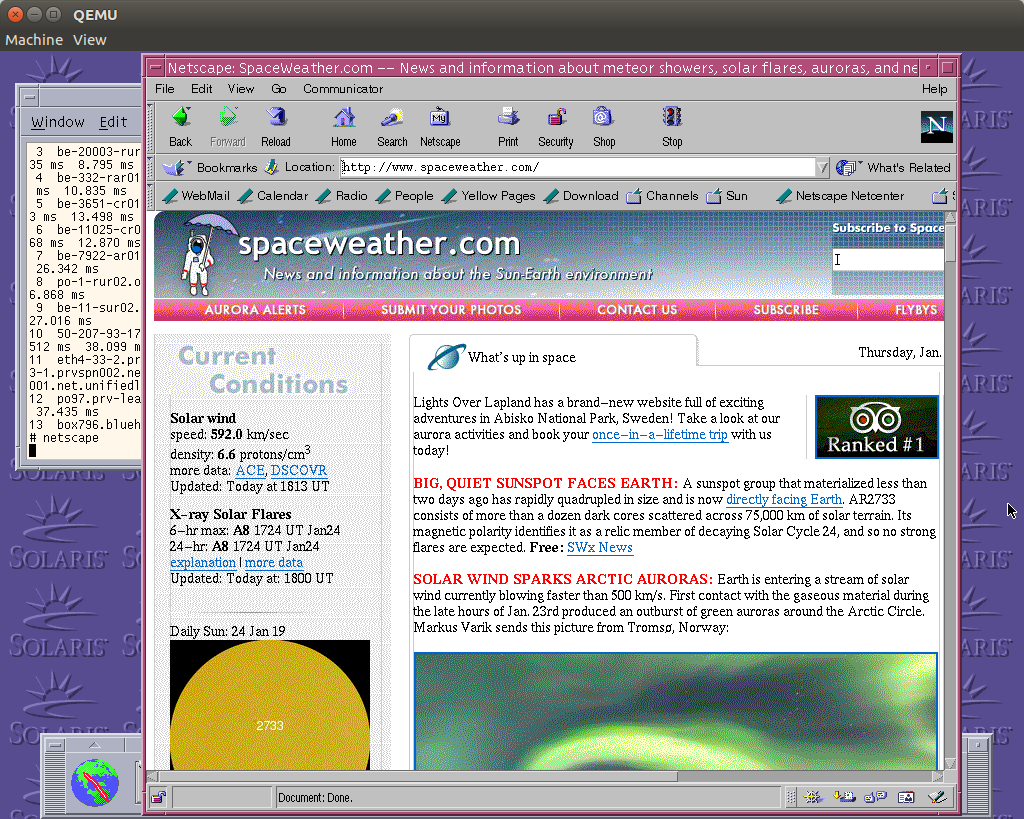


His students launch balloons to the edge of space to conduct research and to carry up trinkets that they sell to fund their missions. If you scroll down on the linked page, you'll see one of the silk roses they sent up on a recent mission.
More details in a discussion from last year:
https://news.ycombinator.com/item?id=20372021